
Is your governance system producing the safety it claims to champion?
Most organizations discover, when they examine their governance model honestly, that some of their own structures actively undermine the psychological safety they promote in leadership training.
The first step is a frank conversation. It usually surfaces the two or three structural contradictions that matter most — and the governance levers most likely to resolve them.
Make your culture perform. Durably.
Build the governance infrastructure that makes psychological safety structurally durable.
You cannot build psychological safety with better managers alone. The environment and systems themselves have to change.
Most organizations know why psychological safety matters. They invest in leadership training. They run engagement surveys. They promote wellbeing. And yet the gap between what management says and what employees experience keeps widening.
The reason is structural. When governance systems reward the absence of errors over the courage to try, when hierarchies tolerate contradiction poorly, when no institutional mechanism protects people from abuses of power — no individual manager, however skilled or well-intentioned, can compensate.
We help organizations build the governance infrastructure that makes psychological safety structurally durable — not a leadership aspiration, but an organizational reality.
What It Is
We live in a paradoxical moment. Organizations have never spoken more about wellbeing, psychological safety, and caring leadership — and employees have rarely felt more unheard, more vulnerable, and more exhausted.
This gap is not the result of bad intentions. It reveals a structural truth that is rarely stated plainly: psychological safety cannot be decreed, and it cannot rest on the shoulders of individual managers.
Why? Because managers themselves operate inside systems that evaluate, reward, and sanction them in ways that frequently contradict the conditions required for safety. How can a manager encourage calculated risk-taking when they are assessed on the absence of errors? How can they protect their teams when they have no institutional recourse against toxic behavior from peers or superiors? How can they promote openness when their own hierarchy tolerates little contradiction?
Our approach starts where most leadership programs stop: at the governance level.
Psychological safety, in this framework, is not a soft competency. It is the measurable output of a set of structural conditions — what we call framework conditions — that organizations can deliberately design, implement, and audit:
- Leadership — the necessary but insufficient starting point
- Framework conditions — the organizational safeguards that protect individuals regardless of who leads
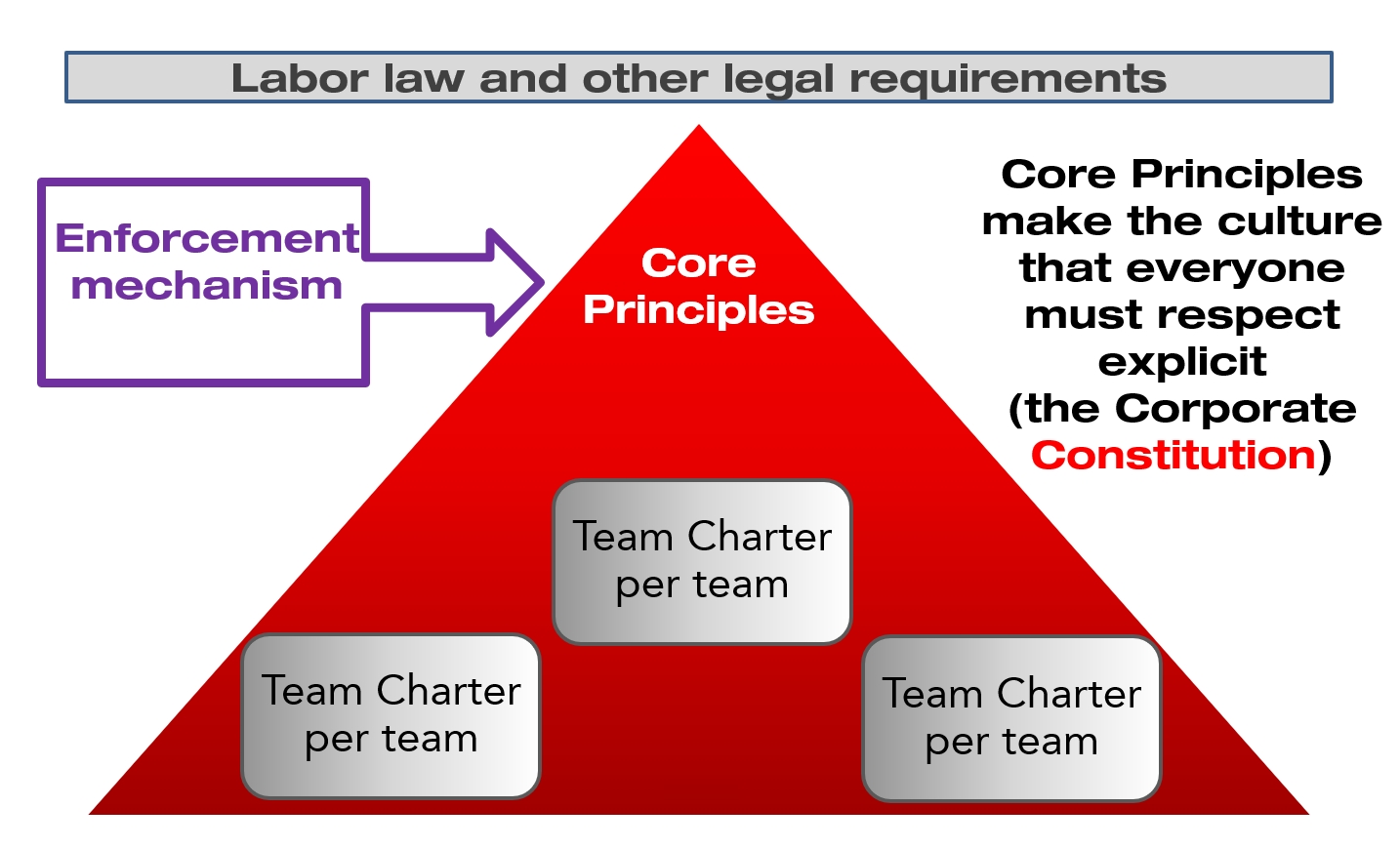
- Rule-based governance tools — the institutional mechanisms that enforce fairness, clarify expectations, and create accountability for behavior: transparency systems, codes of conduct, internal control mechanisms, and governance bodies with a clear mandate to uphold relational standards
- Measurement — tools that track whether the culture you intend is the culture your employees actually experience
- Operational instruments — Charters of Fundamental Principles, Engaged Team Charters, continuous feedback systems, and engagement measurement
This is not a cosmetic exercise. It is a governance redesign — grounded in the conviction that organizations serious about performance cannot afford to leave their human climate to chance, personality, or goodwill alone.
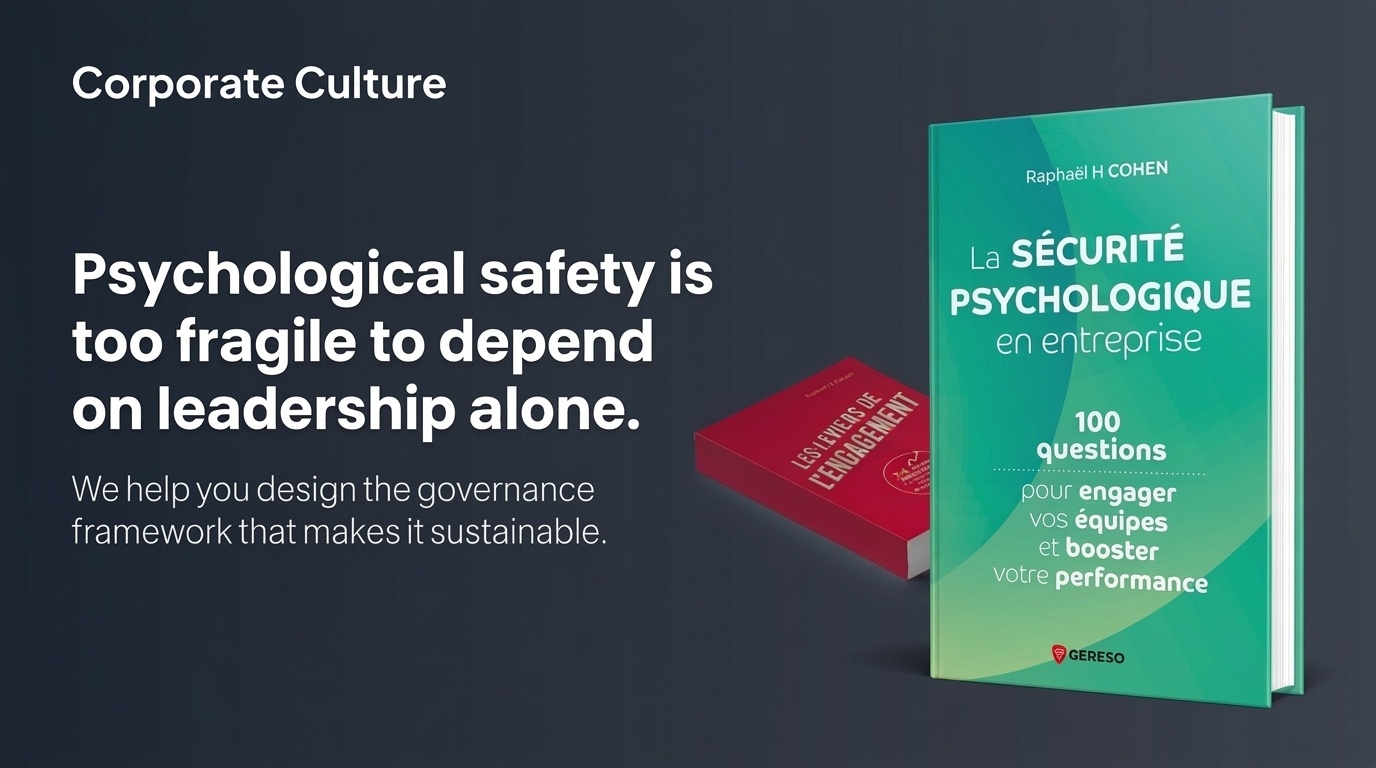
Developed at the University of Geneva. Documented in "La sécurité psychologique en entreprise — 100 questions pour engager vos équipes et booster votre performance" (Gereso, 2026, ISBN 979-10-397-1145-6, 288 pages), prefaced by Philippe Gabilliet, Professor Emeritus at ESCP Business School. Structured around 100 questions that challenge every level of the organization.
Go deeper
Videos & Podcasts



Books

La sécurité psychologique en entreprise — 100 questions pour engager vos équipes et booster votre performance
Raphaël H Cohen — Gereso, 2026 (ISBN 979-10-397-1145-6, 288 pages, €25). Prefaced by Philippe Gabilliet, Professor Emeritus at ESCP Business School.
View book
Les leviers de l'engagement — 54 bonnes pratiques pour entraîner, inspirer et réussir ensemble
Raphaël H Cohen — Eyrolles, 2024 (French)
View bookArticles & Research
Deploying Fairness as a Competitive Advantage
Équité en entreprise
Good Leaders Know When to Be Tough
Qui dirige bien châtie bien
 2012
2012Why Women's Brains Don't Predispose Them to Succeed in Business
Pourquoi le cerveau des femmes ne les prédispose pas à réussir en entreprise
To Reduce a High Invisible Cost, Weed Out Toxic Employees
 2020
2020Methods & tools
EazyMirror — Freemium Web Tool
The measurement instrument that tells you whether the culture you intend is the culture your employees actually experience. Used as the primary diagnostic tool for cultural governance audits — capturing engagement levels, compliance with team rules, and 360° leadership perception across the organization.
Testimonials
The biggest gain for my teams from working with Raphaël has been the ability to think outside the box. Raphaël has truly helped us become a learning organization. His humility and compassion make him a great sparring partner with whom you want to spend time, as you know it is time well invested for the benefit of your employees.
Fort de notre expérience à la RTS, je recommande bien volontiers M. Cohen à toute personne ou entreprise qui souhaite notamment faire évoluer sa culture managériale et sa culture d'entreprise sur des principes de bienveillance et d'équité, dans une perspective humaniste qui améliore la performance individuelle et collective.
La force du Prof. Raphaël H. Cohen est qu'il a toujours été les deux, entrepreneur et business angel d'un côté, professeur et penseur du management de l'autre. C'est de cette double position qu'est née son idée de leadership équitable et bienveillant, où il est aujourd'hui reconnu comme un contributeur essentiel.
What We Do For You

Consulting
We work with your executive team or board to design the structural changes needed to make psychological safety sustainable. This includes:
- Creating a Charter of Fundamental Principles that gives your stated values operational teeth and enforces psychological safety to support maximum performance
- Redesigning enforcement, accountability, and escalation mechanisms that prevent abuse of power
- Designing rule-based governance tools that enforce fairness and create institutional accountability for behavior
- Measuring the gap between stated principles and what is actually happening in the field, to identify what needs to change
Training — Psychological Safety & Governance
A workshop or executive seminar that gives leadership teams a rigorous, structural understanding of psychological safety — and a practical framework for auditing and redesigning their own governance systems.
Not a motivational program. A diagnostic and design tool for senior leaders who are willing to examine the systems they have built.
Keynote Speaking
A direct, evidence-based talk on why psychological safety cannot be achieved through leadership training alone — and what structural governance changes actually produce measurable results. Illustrated with real cases and grounded in published research.